Showing posts with label Math Trick. Show all posts

Finger Multiplication 2


In the Finger Multiplication post, we have learned how we can cleverly multiply numbers from 6 to 10 using  our fingers without memorizing the multiplication table. In this post, we will discuss the reason why this method works.  The proof can be written in a few lines, but since this article falls under the elementary school mathematics category, we will discuss it with more details.
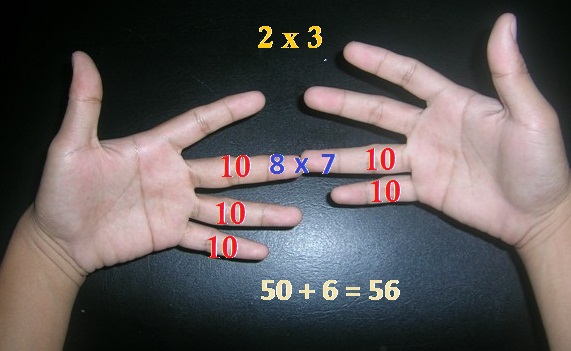
Finger Multiplication of 8 x 7.
Let’s examine the first example in the previous article as shown above. In the example, we wanted to multiply 8 by 7, so we connected the ring and the middle fingers. In this discussion, we will call the connected fingers and all the fingers below them down fingers, while we call all the fingers above them up fingers.
The Down Fingers
There are 3 down fingers on the left hand and down fingers on the right (see figure). We multiplied each of them by 10, and added them up, which equaled 50. Using 8 , 7, and 5 (the total number of fingers on one hand), we can relate down fingers as shown in the following equation: 10(2) + 10(3) = 10(8-5) + 10(7-5). Can you see why?
The Up Fingers
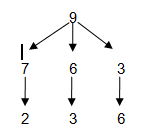
Looking at the up fingers we have 2 at the left and 3 at the right and we  multiplied them to get 6. Note that we can also relate them to 10 (the total number of fingers) as well as 8 and 7, as shown in the following equation: 2 x 3 =  (10-8) x (10 – 7).
Adding them up and Generalizing
Using the equations above, we can express the product P of 8 and 7 using the following equation:
P =  [10(8-5) + 10(7-5)] + [(10-8) x (10 - 7)] = 56
As an exercise, verify if this method works in the second example in theprevious article.
Generalizing, what if we want to multiply the numbers m and n?
We now generalize by multiplying m and n.  The product P is given by the equation P = [10(m-5)+10(n-5) + (10-m)(10-n)].  Simplifying the equation we have P = 10m – 50 + 10n – 50 + (100 – 10m – 10n + mn) = mn. But mn is the product of m and n, which is what we want to show. That is the reason why the  method works.
»»  READMORE...

Multiplication with a series of 9’s


Students often fear multiplication of numbers, which involve lot of 9’s in them. However the truth is exactly the opposite. The higher the number of 9’s in the question, the easier it is to calculate the correct answer.
There can be three cases with multiplication with series of 9’s
  1. Multiplying a number with an equal number of 9’s
  2. Multiplying a number with more number of 9’s
  3. Multiplying a number with less number of 9’s
Here we are discussing Case 1 only and leaving the rest two cases for the readers to explore.
Question: Multiply 764 by 999
  • We subtract 1 from 764 and write half the answer as 763.
  • Now we will be dealing with 763. Subtract each of the digits seven , six and three from nine and write down them in answer followed by 763 one by one.

  • Nine minus seven is two, nine minus six is three and nine minus 3 is six.
  • The half answer already obtained was 763 and now we suffix the digits obtained in previous step. The final answer is 763236
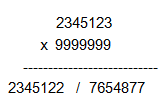
Question: Multiply 2345123 by 9999999
Subtract 1 from 2345123 to get 2345122 as left part of answer. Now subtract individual digits of 2345122 from 9 and write answer as 7654877. This becomes right part of answer. The final answer is 23451227654877
Use of Yavadunam Sutra for Finding square of a number near 100
Sutra Yavadunam function over a base value. The bases may be 10 , multiples of 10 or 100 , multiples of 100 or 1000 , multiples of 1000 etc. Here we limit ourselves to base 100 only.
The sutra says whatever be the difference of the number from the base add (if the number is more than the base) or subtract (if the number is less than the base) that much to the number and on the right hand side set the square of the difference. This gives us the final answer. Remember that the number of digits on right hand side is equal to the number of zeros in base.
Since 108 is 8 more than 100 therefore we have added 8 here as per the sutra and on the right hand side we set square of 8.
Since 98 is 2 less than 100 therefore we have subtracted 2 here as per the sutra and on the right hand side we set square of 2. See that we set 4 as 04 as the right hand side of the answer should have number of digits equal to the number of zeroes in the base.
»»  READMORE...

Finger Multiplication


I was surprised when I came across with an article on Polish hand magic, a strategy for multiplication using the fingers. I remember us doing it when we were in the first grade, but in a slightly different way.  Here in our country, we call it Finger Math or Finger Multiplication.
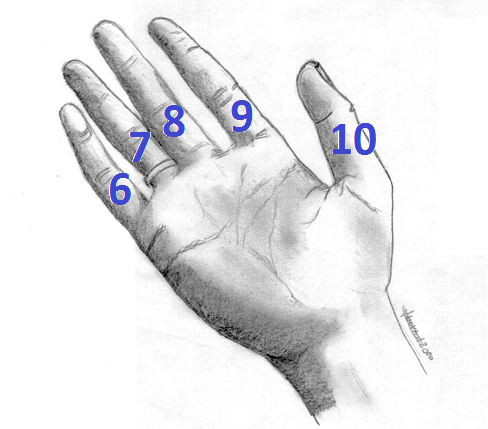
Finger multiplication is a strategy for multiplying numbers from 6-10.  It is used by pupils in the early grades who have not memorized the multiplication table yet.  The idea is to assign the numbers from 6 to 10 to each finger on both hands (see Figure 1): 6 to the pinkie, 7 to the ring finger, 8 to the middle finger, 9 to the index finger, and 10 to the thumb.
Figure 1
To multiply, we do the following (see Figure 2):
(1) Connect the fingers assigned to the numbers that we want to multiply. For example, in multiplying 8 and 7, we connect the middle finger and the ring finger.
(2) Next, we count by 10s the connected finger and all the fingers below them, then add them all up. In the figure, we have 50.
(3) Next, we count by 1s all the fingers above the connected fingers, and then multiply the number of fingers on the left hand to the number of fingers on the right hand.  In the second figure, we have 2 x 3 = 6.
(4) Add the total in 2 and the product in 3. We have 50 + 6 = 56.
Figure 2
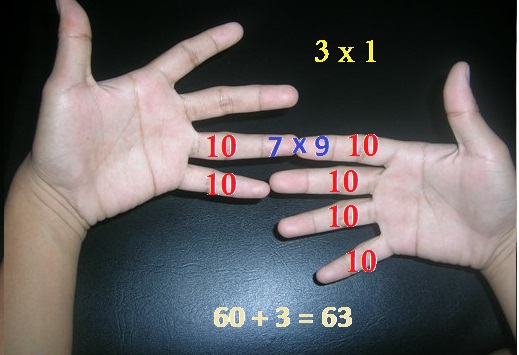
In the second example (see Figure 3), we multiply 7  and 9. We do this by connecting the index finger and the ring finger. Again, we count by 10s the connected fingers below and all the fingers below it. This gives us 60. Next, we count the fingers above the connected fingers by 1 and multiply the total at the left by the total at the right which 3 x 1 = 3. We add up: 60 + 3 = 63.
Figure 3
Now, try multiplying the following if it works: (1) 8 and 6, (2) 9 and 6, and (3) 10 and 0.
Amazed?
»»  READMORE...

Quickly Square Two Digit Number : Up-Down Method

Square a 2 Digit Number, for this example 37:
  • Look for the nearest 10 boundary
  • In this case up 3 from 37 to 40.
  • Since you went UP 3 to 40 go DOWN 3 from 37 to 34.
  • Now mentally multiply 34x40
  • The way I do it is 34x10=340;
  • Double it mentally to 680
  • Double it again mentally to 1360
  • This 1360 is the FIRST interim answer.
  • 37 is "3" away from the 10 boundary 40.
  • Square this "3" distance from 10 boundary.
  • 3x3=9 which is the SECOND interim answer.
  • Add the two interim answers to get the final answer.
  • Answer: 1360 + 9 = 1369

With practice this can easily be done in your head.
»»  READMORE...

Quickliy Multiply Any Number by 11

You can directly write down the answer to any number multiplied by 11.
  • Take for example the number 51236 X 11.
  • First, write down the number with a zero in front of it.051236
    The zero is necessary so that the rules are simpler.
  • Draw a line under the number.
  • Bear with me on this one. It is simple if you work through it slowly. To do this, all you have to do this is "Add the neighbor". Look at the 6 in the "units" position of the number. Since there is no number to the right of it, you can't add to its "neighbor" so just write down 6 below the 6 in the units col.
  • For the "tens" place, add the 3 to the its "neighbor" (the 6). Write the answer: 9 below the 3.
  • For the "hundreds" place, add the 2 to the its "neighbor" (the 3). Write the answer: 5 below the 2.
  • For the "thousands" place, add the 1 to the its "neighbor" (the 2). Write the answer: 3 below the 1.
  • For the "ten-thousands" place, add the 5 to the its "neighbor" (the 1). Write the answer: 6 below the 5.
  • For the "hundred-thousands" place, add the 0 to the its "neighbor" (the 5). Write the answer: 5 below the 0.
    That's it ... 11 X 051236 = 563596
Practice it on paper first! 
»»  READMORE...

Quickly To Multiply Any Two Digit Number by 11


To multiply any two digit number by 11:
  • For this example we will use 54.
  • Separate the two digits in you mind (5__4).
  • Notice the hole between them!
  • Add the 5 and the 4 together (5+4=9)
  • Put the resulting 9 in the hole 594. That's it! 11 x 54=594
The only thing tricky to remember is that if the result of the addition is greater than 9, you only put the "ones" digit in the hole and carry the "tens" digit from the addition. For example 11 x 57 ... 5__7 ... 5+7=12 ... put the 2 in the hole and add the 1 from the 12 to the 5 in to get 6 for a result of 627 ... 11 x 57 = 627
Practice it on paper first!

»»  READMORE...

Quickly Multiply Up to 20 x 20

In just FIVE minutes you should learn to quickly multiply up to 20x20 in your head.  With this trick, you will be able to multiply any two numbers from 11 to 19 in your head quickly, without the use of a calculator.
I will assume that you know your multiplication table reasonably well up to 10x10.
Try this:
  • Take 15 x 13 for an example.
  • Always place the larger number of the two on top in your mind.
  • Then draw the shape of Africa mentally so it covers the 15 and the 3 from the 13 below. Those covered numbers are all you need.
  • First add 15 + 3 = 18
  • Add a zero behind it (multiply by 10) to get 180.
  • Multiply the covered lower 3 x the single digit above it the "5" (3x5= 15)
  • Add 180 + 15 = 195.
That is It! Wasn't that easy? Practice it on paper first!
»»  READMORE...

powered by Blogger | WordPress by Newwpthemes | Converted by BloggerTheme